
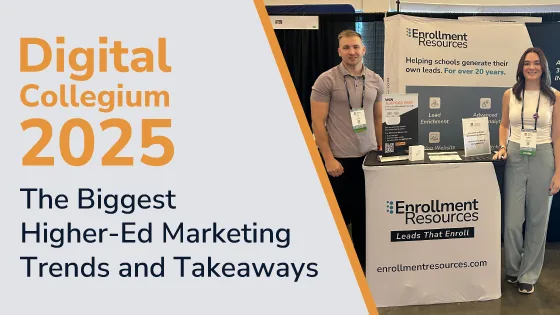
Our team recently attended Digital Collegium 2025 in Grand Rapids (formerly HighEdWeb), where digital leaders from colleges and universities across North America gathered to share what’s shaping the future of higher-ed marketing. From AI to accessibility, the conversations pointed toward one clear theme: higher-ed marketing is entering its next era of connected, student-centric digital strategy.
TL;DR
- AI got practical. Teams moved from “trying tools” to standardizing AI across content, SEO, accessibility, and student communications.
- Findability beat vanity metrics. Teams focused on site structure, zero-click behavior, and search visibility over pageviews.
- Governance and accessibility matured. Centralized systems and compliance prep are currently top of mind for higher ed marketers.
1. AI Moved from Novelty to Workflow
What we saw:
AI is no longer experimental. Teams are using it to draft content, generate metadata, personalize emails, and support accessibility checks. Tools like Custom GPTs and NotebookLM were popular examples of how AI can scale knowledge sharing across departments.
Quick wins:
- Pick 5 repeatable tasks to automate with AI (e.g., drafting, QC, repurposing).
- Centralize your content references- program sheets, FAQs, and brand voice guides.
- Test AI-assisted personalization on one nurture sequence linked to intent data.
2. SEO Is Being Rewritten by AI Search
What we saw:
Search is shifting from ten blue links to AI-driven answers. Content that clearly explains programs, cost, outcomes, timelines, now earns visibility in AI summaries. Schema markup and “job-to-be-done” pages are becoming essential.
Try this:
- Turn top programs into structured “entity” pages with FAQ schema.
- Write short, quote-ready summaries students (and AI) can surface.
- Track drop-offs on Apply, Visit, and Aid pages to uncover intent gaps.
3. Measurement Grew Up
What we saw:
Teams are moving beyond traffic metrics to measure inquiry-to-enrollment attribution. GA4 data is being linked to CRM milestones to calculate cost-per-enrollment.
Next steps:
- Build dashboards showing program-level conversions, not just sessions.
- Layer in labor-market data to prioritize programs and ad spend.
- Report monthly on influenced pipeline and cost per enrollment.
4. Accessibility Became a Strategic Priority
What we saw:
With new ADA Title II requirements on the horizon, accessibility is being built into design systems and content workflows. AI helps flag issues, but human review remains critical.
Do this:
- Add a “test before publish” checklist (contrast, captions, keyboard navigation).
- Use AI to identify issues, but keep human QA as the final gate.
- Offer short, 10-minute training modules for content authors.
5. Performance and Information Architecture = Enrollment Infrastructure
What we saw:
Improving site speed, navigation, and design systems now directly impacts lead quality. Institutions using design systems with baked-in accessibility and clean taxonomy saw measurable conversion lifts.
Checklist:
- Set site-speed targets (LCP, INP, CLS) for high-traffic pages.
- Inventory and document your reusable components.
- Align program taxonomy across your site, CRM, and ad platforms.
6. Governance and Centralization to Scale Personalization
What we saw:
Content councils and centralized CMS governance are helping institutions manage brand voice, compliance, and lifecycle, all prerequisites for personalization.
Action plan:
- Create a content council with marketing, admissions, IT, and accessibility.
- Assign owners and review cadences for each content area.
- Use structured briefs defining audience, schema, and success metrics.
7. Student-First UX Is the New Conversion Engine
What we saw:
The best student experiences were simple: short forms, clear “task pages,” and progressive profiling that collects data gradually instead of all at once.
Implement:
- Cut unnecessary form fields; capture data over time.
- Build task-based pages (Apply, Visit, Aid) with clear next steps.
- Track where students drop off and fix friction weekly.
Teams that connected student behavior data to enrollment outcomes outperformed, the exact gap our Virtual Adviser 6 platform closes by turning intent into smarter targeting, shorter forms, and higher-quality leads.
If you attended Digital Collegium (or want the playbook), our team would love to share what we learned and how to apply it to your site.
Book 30 minutes with the Enrollment Resources team, we’ll share our templates and a sample Virtual Adviser 6 workflow.