
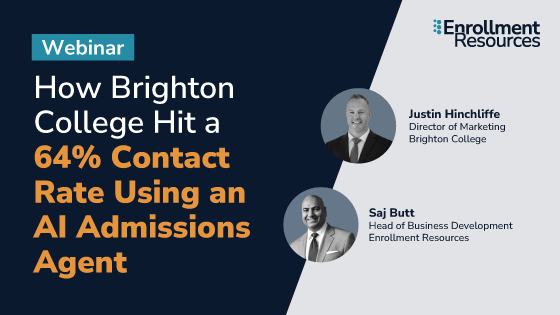
Justin Hinchcliffe on what worked, what he would change, and a live look at the agent
2,200+ leads. Zero first-touch calls. A 64% contact rate.
We recently sat down with Justin Hinchcliffe, Director of Marketing at Brighton College, to walk through the AI Admissions Agent pilots he oversaw at two very different schools, Brighton College and Alexander College. He covered both honestly: the setup, the results, and what he would do differently from day one. Here is a recap of the conversation, the live demo.
Access the full recording here.
What problem was Brighton College trying to solve?
Justin’s team wanted to grow revenue and test new marketing channels like Meta, TikTok and YouTube without flooding the admissions team with unqualified leads. These channels make it easy and cheap to generate inquiries, but in the past that volume came at a cost: reps burning time on people who barely remembered inquiring. The goal was to keep passing only quality leads to admissions while still opening up those new channels.
Why start with Meta leads?
Brighton’s audience skews toward mature students in their mid-20s to 30s who are looking to change or upgrade their careers, and Meta reaches that group well. The catch is that Meta casts a wide net, so many of those leads are window shopping rather than seriously considering a return to school. Justin’s thinking: there is real gold in that channel, but you need a way to find it without exhausting your reps.
What drove the 64% contact rate and 78% booking rate?
Speed to lead was the biggest factor. The agent contacts every lead within about 60 seconds and never misses, and Justin noted prospects are far more likely to connect when reached within five minutes rather than thirty. It also covers evenings and weekends, when many inquiries actually come in. One long weekend, the team walked in Monday morning to 15 appointments already booked. From there, only 51% of Meta leads turned out to be genuinely interested, which is exactly why qualification matters before handing anyone off. The 78% booking rate came from baking value into how the appointment is framed, so prospects understand what they will get from meeting a rep, which also sets the admissions team up to close.
How did the Brighton and Alexander pilots differ?
They are two different schools with two different audiences. Brighton is focused on vocational training and career change, while Alexander College is more academic and recruits international students, where response time dropped from four hours to under 10 seconds. For Alexander, the team runs around 20 campaigns across 10 countries, using the agent for first outreach in multiple languages, and has seen appointment booking rates as high as 80% in some regions.
What does the ideal inquiry-to-appointment workflow look like?
Justin recommends mirroring the outreach cadence you would already build for your admissions team, for example around 10 contact points over seven days. The agent sends an email and SMS right away, follows with a call, and adjusts based on whether the prospect responds. It opens with an open-ended discovery question, then works through a short set of qualifying questions (why they inquired, their schedule, whether they are working, citizenship) that feed straight into the admissions process.
Where do human admissions reps still matter most?
Human connection cannot be replaced, and Justin was clear on that. Once a lead is qualified, the relationship building and trust that carry a student through their decision are firmly the rep’s job. The principle is human in the loop: let the agent handle qualification and discovery, but keep critical admissions decisions with people.
What would you do differently?
Insist on built-in anti-hallucination from day one. Early in the pilot, the agent said something subtly off-brand and Justin had to call the prospect back to apologize, which was the moment he knew the system had to change. His warning: a line in the system prompt is not enough. The platform itself needs a validation layer. Technically, the strongest approach he has seen uses a small, fast language model that checks each response before it is spoken, rather than a slower second model that can let an error slip out before correcting it. That lag is fine for chatbots, but it breaks the flow of a live voice call.
How do you handle compliance and guardrails?
Justin drew a hard line between a “wrapper” (loosely bolted-together tools with no real control and no hallucination protection) and a system built at the research layer. Good guardrails define exactly what the agent can and cannot discuss, steering complex topics like detailed tuition, job outcomes and immigration back to a human rep. He also flagged consent, disclosure, escalation pathways and recording consent as compliance essentials that vary by state, country and region, so check your local requirements.
How much admissions team training is required?
Very little. The agent connects to your admissions calendars and routes appointments straight into the CRM, so reps simply meet the prospects who show up. Brighton gave its agent a unisex name, Bex Ellis, partly to A/B test voices, and reps just need to know that an appointment from Bex Ellis is a qualified hand-off. They can still see the lead source and get a full conversation summary, so they start each meeting well ahead of a cold call.
Where else can an agent add value?
Justin sees strong potential further down the funnel, especially anywhere outreach or information gathering is involved: job market surveys through career services, follow-up calls, and midpoint or quarterly satisfaction check-ins to gauge how students are doing.
See ConnectIQ in Action
In the live demo, Enrollment Resources CTO Andrew Becker walked through the new ConnectIQ interface in Virtual Adviser, showing real-time agent activity from inquiry to booked appointment.

See it built for your school. Book a custom demo and we will show you exactly how ConnectIQ would work with your programs, lead sources, and CRM.
Audience Q&A
What was the bottom of the funnel impact from this pilot?
Justin was able to share that acquiring a student through Meta paired with the AI agent came in about six times cheaper than through Brighton’s traditional Google and human workflow.
Does the prospect know they are speaking with AI?
It depends on your state or region. In Canada, Brighton opts prospects in through its marketing channels, so the agent does not need to declare itself on the greeting, though it will confirm if asked. When Justin dug into the data, only 2.7% of prospects asked whether they were talking to an AI, and of those, 70% carried on and booked while 30% asked for a human. Always check your local compliance rules.
Can the agent work with all our leads, or only those who complete the career assessment quiz?
Entirely your call. It can be scoped to specific lead sources, days and hours, or opened up to every lead. It is highly customizable, and with nearly 20 years working alongside 500 schools (about 70% in the US), the ER team can help navigate compliance down to the state level.
What does it cost?
Please reach out to our team to get more information on our current pilot program.
How should we identify the agent at the start of a call?
This comes down to compliance, so check your local laws. Justin prefers “virtual assistant” language and noted that most prospects are comfortable continuing even when they know it is AI, so there is little reason to shy away from a clear, compliant introduction.