
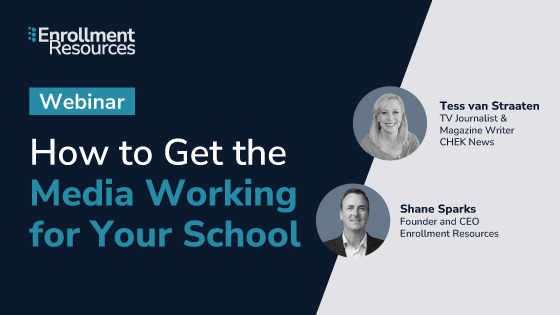
For schools looking to increase visibility, build credibility, and attract prospective students, media coverage can be incredibly powerful. A story featured on local television, in a newspaper, or on a community news site can reach thousands of families and position your institution as a leader in education.
Yet many schools struggle to get media attention. Press releases go unopened. Story ideas never receive a response. Often the issue isn’t the story itself, it’s how it’s presented.
During a recent webinar, veteran TV journalist Tess van Straaten shared insights from more than 25 years in the newsroom. Her advice offered a behind-the-scenes look at how journalists decide what stories make the news and how schools can significantly improve their chances of getting coverage.
Her core message was simple: if you want media coverage for your school, start by thinking like a journalist.
Why Media Coverage Matters for Schools
While digital marketing plays a major role in enrollment marketing, earned media provides something advertising cannot: credibility.
When a journalist tells your school’s story, it carries authority and trust with the community. Local media also plays an important role in connecting people with what’s happening in their area.
As Tess explained: “You can get national and international news anywhere. But to get truly local news, you have to follow your local newspaper, TV station, or radio station.”
That local focus creates a natural opportunity for schools. Many education stories directly impact families and communities, which makes them strong candidates for local media coverage.
What Makes a School Story Newsworthy
Understanding what journalists consider newsworthy is one of the most important steps in getting media coverage for schools. According to Tess, most stories fall into a few core categories.
Human Interest Stories
Human interest stories are often the most compelling type of story for schools. These focus on real people and experiences that audiences can connect with emotionally. “We want to talk to real people,” Tess said. “People identify more with these real people-centric stories.”
For schools, this might include highlighting a student overcoming obstacles, a teacher using an innovative approach in the classroom, or a program helping students enter high-demand careers.
Stories That Are Unique or Unexpected
Sometimes the most compelling stories are simply unusual. If your school is doing something innovative or unexpected, that alone can attract media interest.
Stories With Community Impact
Journalists constantly evaluate stories through one key lens: relevance to their audience. As Tess explained, reporters are always asking: “Why does this matter to our audience?”
Even national issues can become local stories when they connect to people in the community. For example, a national conversation about labor shortages can quickly become relevant if a local school is training students for those in-demand jobs.
How Newsrooms Actually Work
Many people assume journalists plan stories weeks in advance. In reality, most newsrooms operate on extremely tight timelines. In television news, reporters often pitch ideas early in the morning, conduct interviews and gather footage throughout the day, and finalize stories just hours before the evening broadcast. As Tess described it: “It’s a hustle.”
Because of these tight deadlines, schools that respond quickly to media inquiries often have a significant advantage. If a reporter needs a quick interview, expert insight, or visual footage, responsive schools are far more likely to be featured.
How Schools Should Pitch Journalists
Sending mass press releases to generic newsroom inboxes rarely works. Journalists receive dozens, sometimes hundreds, of pitches every day. Instead, schools should focus on identifying reporters who cover education or community stories and building direct relationships with them. “I’m more likely to push forward stories if someone emails me directly,” Tess explained.
Over time, journalists tend to return to sources who consistently provide helpful information and compelling stories.
How to Write a Press Release for a School
A well-written press release can make it easier for journalists to quickly understand and evaluate your story. A few simple principles can make a big difference. Start with the most important information. Journalists typically follow an “inverted pyramid” style, meaning the key details appear right at the beginning.
Use clear, simple language. Avoid academic jargon and make the story easy to understand. Write a strong headline. Tess shared an example of a research report that initially received little attention. When the headline was rewritten as “Driving tired is worse than driving drunk,” it quickly generated national media coverage.
Finally, keep it concise. Journalists do not have time to read long documents, so shorter press releases are far more effective.
Make the Story Easy for Journalists to Cover
One of the most effective ways for schools to get media coverage is to make the journalist’s job easier. Tess described this approach as creating “one-stop shopping” for reporters.
Schools should be ready to provide a spokesperson, students or faculty who can share personal experiences, and visual opportunities such as classrooms, labs, or activities. When reporters can quickly gather interviews and visuals in one place, the story becomes much easier to produce.
Final Thoughts: Think Like a Journalist
Schools often approach media outreach from their own perspective. Journalists, however, are always thinking about what will resonate with their audience. Before pitching a story, ask a simple question: Why should people care?
As Tess emphasized during the webinar, that question sits at the heart of every news story. “Why does this matter?” When schools clearly answer that question, they dramatically increase their chances of earning meaningful media coverage.
Watch the Full Webinar and Get the Tips & Tricks Guide
Getting media coverage is just one piece of a strong school marketing strategy. At Enrollment Resources, we help schools turn their websites and marketing efforts into consistent enrollment growth through proven conversion strategies, messaging, and digital optimization. If you’re looking for ways to attract more qualified student inquiries and turn interest into enrollments, we’d love to help. Book a meeting with our team to see how we can support your school’s growth.
FAQ: Getting Media Coverage for Schools
How can schools get media coverage?
Schools can get media coverage by pitching stories that are relevant to their local community, highlighting real people and student success stories, and building relationships with journalists who cover education or local news.
What makes a school story newsworthy?
A school story is most likely to receive coverage if it includes a human interest angle, highlights something unique or innovative, or connects to a larger issue that impacts the local community.
What should a school press release include?
A school press release should include a clear headline, the most important information in the first paragraph, quotes from relevant sources, and contact information for media inquiries. It should also be concise and written in simple language.