
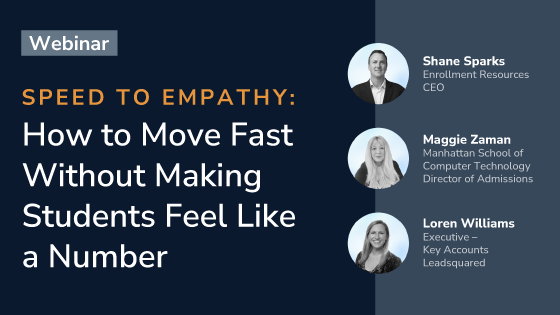
Students expect instant responses. They also expect to feel like a person, not a record in a workflow. Holding both at once is the challenge at the heart of modern admissions, and it was the theme of our recent webinar, Speed to Empathy, hosted with LeadSquared.
The conversation brought together Shane Sparks, Founder and CEO of Enrollment Resources, and Maggie Zaman, an admissions leader with 25-plus years of experience at Manhattan School of Computer Technology, with LeadSquared's Loren Williams, Executive - Key Accounts. We’ve condensed the 1 hour webinar, into a 5 minute read you can take back to your team.
Empathy is not a nice-to-have. It is table stakes.
Shane framed speed to empathy as the ability to connect with a human being, and he was blunt that it is not optional.
"Our ability to connect with students is the core differentiator for vocational schools. We fundamentally win at that. It's table stakes is how I think about it." — Shane Sparks
The instinct in the era of purchasing lead lists was to chase and pursue prospects, an approach he called miserable for everyone involved, students and admissions reps alike. The alternative is to draw people in rather than chase them. "We devised a method to bring the person in, draw them in versus chase them," he explained, "and we did that through thoughtful questions. What is it you want? How do we help you explore what that is?" That shift, from pursuit to invitation, is what makes the connection feel human.
Why the first moment matters more than you think
We all know speed-to-lead drives conversions. Shane offered a theory on why.
"That human being filling out that inquiry form has opened themselves up to being very vulnerable. And that's a transformational moment." — Shane Sparks
Choosing a school is not like picking a product off Amazon. It is closer to booking a first counselling appointment, a moment where the window of courage can slam shut as fear creeps back in. As Shane put it, "they're open to a big change in their life, and may retreat from that if we don't get to them quick enough."
And it is less about competition than you might assume. Our research shows only about 15% of students say they are inquiring at other schools. So the urgency is not mainly that someone else will get there first. In Shane's words, "I'm open now. I might not be open five minutes from now."
Maggie added the other half of the equation. "About 80% of prospective students who go on websites and receive an instantaneous response usually end up completing the student journey with that college," she said, "as long as it's followed by that human touch." Speed gets you in the door. Empathy keeps you there.
What makes a student feel heard
Maggie shared a technique any rep can try on their next call: ask the meaning behind someone's name.
"I'll say, you have a very pretty name. Can I ask, is there a meaning behind your name?" — Maggie Zaman
Her own name, Margarita, is the Mexican word for daisy, and she has learned there are around 1,600 varieties. When she asks a student about their name, she is often invited into a story about a grandmother, a heritage, a family bond. "It's a very insightful moment that not everyone gets to be invited into," she said. That small moment of curiosity turns a transaction into a relationship.
The risk on the other side is sounding robotic. Maggie described a call from that very morning where a student asked whether the rep was AI, "because this person came across so robotic and they were wondering if the person was real." Her fix is not more coaching on tonality. It is less. "I need you to be you. I need you to be genuine," is how she coaches her team. As Shane added, in an insincere, AI everywhere world, sincerity is the only real differentiator left. "The only tonic for that is to lean into the humanity of the whole thing."
Where automation helps, and where it does not
Both panelists were candid about the limits of the tools. Shane's read on website chatbots was refreshingly unsentimental: "It's a C tactic. It's not an A tactic. It may or may not be any better than not having one."
The bigger opportunity, he argued, is in AI voice and text agents that handle first contact, especially for after-hours leads and smaller teams without a dedicated outreach desk.
"The AI agent has great potential as a first point of contact. We're seeing greater contact rates and greater booked appointment rates." — Shane Sparks
Maggie's rule of thumb keeps automation honest: "If it feels that way to me, I have to change at least one line of that message so it becomes more personalized to that student." About 65% of students like automation, she noted, but they also want a clear path to a real person. Her guiding principle is simple: "We have to meet the student where they're at." Whether that is text, email, phone, or an after-hours tool, the goal is to move them into a live discovery conversation.
The research: students are more uncertain than ever
We analysed 800,000 prospects over three years to see what had shifted. The barriers held steady. Money is still the primary concern, and worries about family, transportation, and diplomas have not moved much. The one thing that changed is certainty.
"This uncertainty has changed a lot in the last three years. They're coming to us more anxious, and much less certain about the program they want." — Shane Sparks
One client question made the point vividly: what share of inquiries actually enrol in the program they originally asked about. The answer was 51%. Nearly half chose a different path, not by design, but because they came in fleeing a frustration rather than chasing a clear goal. That is the opening for admissions. As Shane described it, what these students need is "a sympathetic ear that can draw out the person," connect that to a worthy goal, and offer a little encouragement.
Handoffs are where empathy is won or lost
Maggie called the handoff between departments "the million-dollar question." A strong CRM keeps the student's story intact so they never have to repeat themselves, and never sense a breakdown between admissions, financial aid, orientation, and academics. Without that continuity, she warned, the student starts to wonder, "Did you not listen? Did you not gather who I am?"
The first impression becomes the benchmark they measure every later interaction against. Her philosophy comes down to three words:
"It's that word of, I've got you. I've got you, Maria. I've got you, Stephen. No worries, we've got this together." — Maggie Zaman
When a student feels held through every step, continuity replaces the stop-and-start that quietly erodes trust.
Two things to do tomorrow
Shane's challenge: give your people permission to be themselves. Over-prescribe how to behave and you lock them up. "Allow the spirit of your people to shine," he said, "and notice when it's not happening. They're going to need permission."
Maggie's challenge: take a step back and read your own communications, call guides, and interview scripts through the eyes of a student. Not the student you imagine, the real one. "What does that look like in the eyes of the student?" she asked. If it reads generic, it probably feels generic.
The takeaway
Speed and empathy are not a trade-off. The schools that win pair fast, consistent systems with people who are unmistakably human. The catch is that you cannot add a personal touch to someone you know nothing about, and as the research showed, today's prospects arrive more uncertain and more anxious than ever.
That is the gap Virtual Adviser is built to close. Our prospect intelligence lead funnels gather real information on every prospective student: their barriers, their motivations, and their personality profile. Your admissions team walks into the very first conversation already knowing what matters to that person, so there are no generic openers and no starting from zero.
And because Virtual Adviser integrates seamlessly into your CRM, you decide how that intelligence gets used. Follow up in a human way when the moment calls for it, or automate the right pathways when speed is what counts. Either way, every touch is informed, personal, and built on what the student actually told you.
Want to see how Virtual Adviser helps your team connect faster and more genuinely? Book a walkthrough and we will show you.