
Ask any school what it needs, and the answer is almost always more leads. Manhattan School of Computer Technology (MSCT) took a more holistic approach.
Instead of chasing more inquiries, the team fixed the admissions foundation and the numbers show it worked:
- Starts up 21.7%. Year to date in 2026 compared to the same period in 2025.
- Summer starts nearly doubled. June through August, a traditionally slow period, produced 217 starts, up from 110.
- Drop rate cut by more than half. Down from 43.6% to 18.4%.
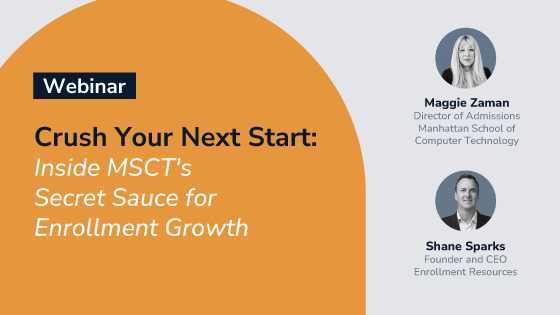
In our September 22 Crush Your Starts webinar, MSCT's Director of Admissions, Maggie Zaman, walked us through exactly how they did it.
Key takeaways
- Process first, leads second. MSCT stopped staring at enrollment numbers and started fixing the steps that produce them.
- Audit 10 leads every week. Following individual students end to end shows exactly where they stall.
- Don't automate a broken process. Define it first, then let your CRM speed it up.
- Certify your reps. MSCT's 7-day training program ends in a certification with a 75% pass mark.
- Hire for your market. Speaking a prospect's language builds trust instantly.
- Your website should convert, not just attract. After ER launched MSCT's new site, bookings rose 88% on just 9% more traffic.
The problem with "we need more leads"
We opened the webinar with a poll. If you could fix one thing before your next intake, what would it be? Sixty-three percent of attendees said leads.
Maggie gets it. She's asked for more leads herself. But she learned that volume isn't the real lever. "It's not always about 'we need more leads,'" she said. "It's more about what are we doing with the current leads that we have?"
Admissions expert Joe Girard made the same case in a recent session: consistent enrollment comes from a better conversion system, not more leads.
That gap between inquiry and start is where most schools quietly lose students. It's also where MSCT found its growth.
Where MSCT started
The early days were rough. One of Maggie's first start dates at MSCT closed with just five students. "It was very revealing for me," she said.
The turning point wasn't a new tool or a bigger budget. It was a shift in focus. "Instead of looking at outcomes, which is enrollment, we started looking at the process," Maggie said. "That's something that really radically changed for us."
In practice, that meant:
- Mapping every step from inquiry to start
- Giving every step an owner
- Measuring every step, so gaps show up before they cost a start
How to find the leaks: the 10-lead audit
Reports show you what happened. They rarely show you why. So Maggie built a simple weekly habit.
"Take 10 leads, study them from beginning to end, and identify where those gaps may be," she said. Each week she picks 10 students from her conversion report and traces their full journey.
Those audits turned up three very different problems:
- Missed handoffs. Some students fell through the cracks between admissions and financial aid.
- Slow speed to lead. Leads came in, but the team wasn't booking appointments fast enough.
- Inconsistent interviews. Some presentations skipped steps, so students never connected the program to their own goals.
The gaps also varied from rep to rep. That told Maggie that one-size-fits-all training wouldn't cut it.
Define first, then automate
Saj shared something Maggie told the Enrollment Resources team before the webinar: automating a broken process just makes the mess run faster.
MSCT uses a CRM, but only after the process behind it was defined. "We couldn't just automate," Maggie said. "We had to make sure our processes were defined first before we could really automate and be effective with that."
She was blunt about how schools think about technology. "We confuse technology with transformation," she said. "The transformation can only come from your people, your processes and the accountability that comes with that."
As Enrollment Resources founder Shane Sparks put it, “there's no solution you can simply buy to fix this”.
How MSCT trains and certifies admissions reps
MSCT's admissions team grew from about 3 reps to roughly 10, alongside around 10 outreach staff. Growth that fast usually breaks a process. MSCT protected it with formal training.
Every new advisor completes a 7-day program. It covers:
- MSCT's philosophy and values
- Compliance, including FERPA and a clear list of do's and don'ts
- Core admissions skills
To get on the floor, each advisor has to pass a call and interview certification with 75% or higher. They get three attempts. Any compliance slip means an automatic retake.
The certification checks four things:
- Compliance. Non-negotiable.
- Discovery. Is the rep really listening and connecting with the student?
- Presentation. Start dates, courses, tuition and support resources.
- Next steps. A clear summary and a program recommendation.
That last one matters most to Maggie. She wants advisors who recommend, not order takers.
Training doesn't stop at certification. Every week, Maggie reviews each rep's CRM dashboard, audits leads and trains on whatever the data shows. That might be speed to lead, positioning or the student experience.
Hire for your market
Brooklyn is one of the most diverse markets in North America. MSCT leaned into that. The team now includes advisors who speak Urdu, Mandarin, Spanish, Russian, Ukrainian and Uzbek, with close to one advisor for each language.
"There's a level of trust that language breaks through immediately," Maggie said. That's especially important at a school whose largest program is English as a Second Language.
Culture does the rest. Maggie described MSCT's culture as one of "transparency, accountability, ownership and pride." She tells her team that every inquiry is someone reaching out for help. "If it's not you, then who?"
Better conversations, fewer drops
In 2025, 43.6% of MSCT's starts ended in a withdrawal, dismissal, termination or SAP dismissal. In 2026, that rate is 18.4%. Total drops fell from 191 to 98.
Maggie credits the front end. When advisors set clear expectations, ask better questions and recommend the right program, the students who start are more likely to stay. "We were also able to impact the quality of the conversations that we were holding with our students," she said.
Her reminder for anyone relying heavily on automation: "Automation cannot replace the human touch. We have to be high tech, but we have to remain high touch."
Data, campaigns and a website built to convert
On the marketing side, MSCT partnered with Enrollment Resources on:
- Lead attribution
- Lead scoring
- Campaign optimization
- A new website, designed and built by Enrollment Resources
The data gave Maggie confidence in her spending decisions. "The data that we received from you allowed us to know when we could move up and spend more," she said, "or where we needed to stay until we could get greater control over the conversions."
The results show up in the attribution data. Starts from Enrollment Resource's sourced leads grew more than 8x higher YoY when comparing 2026 YTD to the same period in 2025.
Enrollment Resources launched MSCT's new site on May 28, 2026. Here's how the 12 weeks after launch compared with the 12 weeks before:
- Traffic grew 8.9%.
- Prospects grew 43.2%.
- Bookings grew 88.3%.
- Conversion rate rose from 4.0% to 5.3%.
Traffic barely moved, but bookings nearly doubled. The new site isn't just busier. It converts.
How long does an admissions turnaround take?
It depends on leadership. Maggie has led turnarounds that took about two years, including one school that grew from 150 to 700 students. But none of it works without buy-in at the top.
At MSCT, she had that support. "There is no time," she said. "You have to drive with urgency."
What's next for MSCT
With a solid foundation in place, MSCT is:
- Formalizing an international admissions program
- Growing high school admissions
- Exploring new programs for 2027
- Looking at New Jersey and Florida further down the road
Maggie's advice to schools eyeing expansion: "Make sure your backyard is really secure" first. Growth has to be sustainable. Without the right people, training and process behind it, "it's going to crumble."
Frequently asked questions
How can a school increase student enrollment without buying more leads?
Focus on what happens after the inquiry. Map your process from inquiry to start, give each step an owner, and measure speed to lead, appointments, show rates and handoffs. MSCT grew starts 21.7% year over year by closing these gaps.
What is a lead audit in admissions?
A lead audit follows a small sample of inquiries from first contact to start, so you can see exactly where students stall. MSCT audits 10 leads every week.
How do you reduce student drop rates?
Start with better admissions conversations. Clear expectations, real discovery and honest program recommendations mean the students who start are the right fit. MSCT cut its drop rate from 43.6% to 18.4%.
Should schools automate admissions with a CRM?
Yes, but only once the process is defined. Automation speeds up whatever process you already have, including a broken one.
How should we identify the agent at the start of a call?
This comes down to compliance, so check your local laws. Justin prefers "virtual assistant" language and noted that most prospects are comfortable continuing even when they know it is AI, so there is little reason to shy away from a clear, compliant introduction.
Can a new website increase student enrollment?
Yes, if it's built to convert. After Enrollment Resources launched MSCT's new website, bookings rose 88.3% while traffic grew only 8.9%. The conversion rate went from 4.0% to 5.3%.
How long does an admissions turnaround take?
It depends on leadership support. With strong buy-in, change can show within months. Maggie Zaman has led larger turnarounds over about two years, including one school that grew from 150 to 700 students.
Hear the full story. Watch the Crush Your Starts webinar recording to hear Maggie Zaman walk through MSCT's turnaround in her own words. When you're ready to crush your next start, talk to the Enrollment Resources team.